Yesterday evening I attended the beginning of a new series of lectures at the Museum of Fine Arts, Houston. "Conversations with the Director," in this case Gary Tinterow, generously supported by Louis Vuitton, had invited artist Jeff Koons for a discussion of Picasso's work featured in the museums current exhibition, "Picasso: Black and White." Now, I will be honest, I have seen the show and already reviewed it here, I really just wanted to see Jeff Koons. Koons is one of those artists that has kind of bad-boy pop star quality in the arts. He was married to an Italian porn star and created many works involving close-ups of the female anatomy, and of himself with his former wife. Aside from the shock value of those works, he really does take his work seriously, as did Picasso, and that I cannot help but admire and it always helps to learn something new.
Koons' work is primarily centered around mass media and consumerism; from plastic inflatables, to steel balloon dogs, to the appropriation of art historical works into contemporary pieces, his work is a commentary on how we consume images and objects much like the works of Andy Warhol, Robert Rauschenberg and David Salle. These are pieces that can be appreciated aesthetically and on the surface by anyone, and for those of us art history geeks, there is a bit of a private joke for us to enjoy.
Shortly after Koons graduated from the Art Institute of Chicago he exhibited Vacuum Cleaners encased
 |
| Chicago Sculpture, image from Wikipedia. |
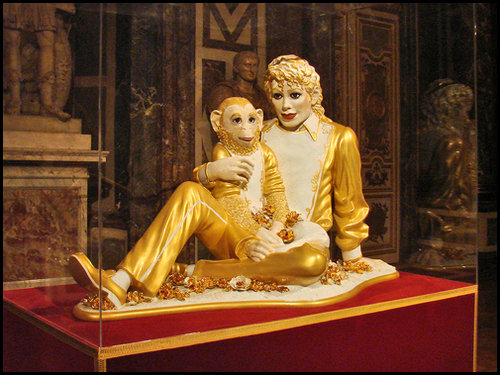
in poly-acrylic boxes, basketballs in water-filled tanks and created the now famous/infamous sculpture of
Micheal Jackson with his monkey, Bubbles. The buzzwords last night that kept emanating from him were "generosity and intuition." From what I gathered he seemed to think of his and Picasso's works as an allegory for humanity and acceptance.
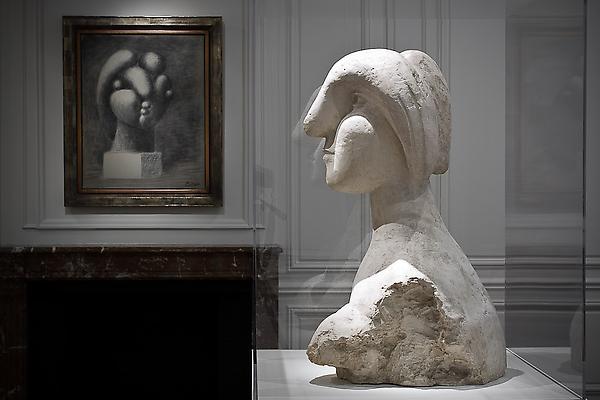
To illustrate the idea of generosity, Koons sited the 50 ft. cubist sculpture that Picasso donated to the city of Chicago in 1967 that is displayed in Daley Plaza, known as the "Chicago Sculpture". Picasso created so many works, but often I think a lot of people don't realize how much work went into his thought process. To illustrate this idea of the "intuitive", Koons and Tintero presented a finished drawing (
Study for a Sculpture of a head, 1932) of a sculpture that Picasso created. He created the two dimensional drawing first, but the subject matter was in three dimensions complete with cast shadow, mass shading, tonal values, a vignette background, highlights and realistic geometric perspective. Tinterow pointed out that he (Picasso) was always thinking in 3D, but created it first in 2D and then created the sculpture (
Sculpture of a head at Aquavella Gallery, Oct 2008).
When thinking about both Koons and Picasso as sculptors one has to consider the process from going
 |
| "Puppy" in Bilbao, image from Bluffton.edu |
from small scale to monumental. Though Koons
Balloon dogs illustrate this rather efficiently, as you go from a transparent, fragile plastic for lack of a better word "toy," to the imposing reflected steel, Koons commentary on this work was that as people we feel as though the world is a void and we are filled always looking out and that he wanted to reverse that have the work be filled reflecting the void around it. What I found more interesting was work that I had seen before but never really thought about as far as "why." "Puppy" is a 43 ft. tall Topiary sculpture of a white terrier that was created with an estimated 60,000 live plants. Koons brought up a good point that once the work was created, ie. planted, he lost control of the look of the sculpture as the plants grow in various natural ways and tend to take over the work. What I found most interesting about this work is that the stainless steel armature holds a self-sustaining irrigation system, showing to me that the work was well-thought out.
Going back to Picasso's paintings, Tinterow pointed out that many of the works in the exhibit are of the
 |
| Titan, Venus and Adonis, ca. 1550, image from TheMetMuseum.org |
female form. He also pointed out that there was a relationship between this, Picasso's lover. Marie-Therese and Titan's Adonis and Venus, ca . 1550. Marie-Therese was around 15 or 16 years old when Picasso about age 45 took her as his mistress. There was a bit of role reversal as Picasso aged, where he became the Venus clinging to the younger Adonis. Koons, who owns Picasso's
"The Kiss," 1969, combined these two paintings for his latest Antiquity series as a ground for the Venus figure and Irish Tribal leader in the center of the work. Koons pointed out that the figure had both a phallas and breasts. The phallas represented the strength that tribal leader had to provide as a warrior and the breasts as a means of nurturing his people. Koons also referred to this as the 'biology of connection,' something which resonates with me as
 |
| Jeff Koons, Antiquity 3, image from Sleek-mag.com |
a follower of contemporary art, wherein we pull or appropriate images from the entire lexicon of art history to create a new work that has relevance for the same issues that we have always dealt with as human beings both collectively and individually. Unfortunately, I could not find an image on the web of the work that showed how these two paintings and the objects were combined. However, I did find this piece and it illustrates the same ideals/principals discussed here minus the Picasso reference.





No comments:
Post a Comment